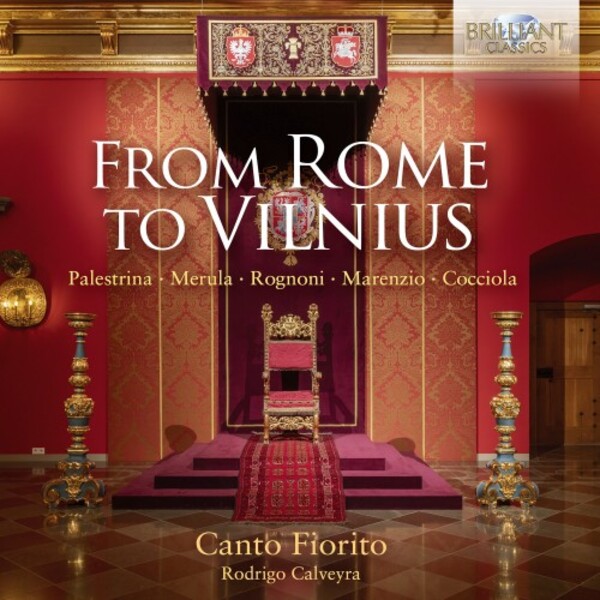
From Rome to Vilnius: Palestrina, Merula, Rognoni, Marenzio, Cocciola
£9.45
In stock - available for despatch within 1 working day
Despatch Information
This despatch estimate is based on information from both our own stock and the UK supplier's stock.
If ordering multiple items, we will aim to send everything together so the longest despatch estimate will apply to the complete order.
If you would rather receive certain items more quickly, please place them on a separate order.
If any unexpected delays occur, we will keep you informed of progress via email and not allow other items on the order to be held up.
If you would prefer to receive everything together regardless of any delay, please let us know via email.
Pre-orders will be despatched as close as possible to the release date.
Label: Brilliant Classics
Cat No: 97227
Format: CD
Number of Discs: 1
Genre: Vocal/Choral
Release Date: 11th October 2024
Contents
Works
O quam suavisO vere digna
Canzon diomedis
Cantabant sancti
Laetemur hodie
Magnificat for 8 voices
Canzone II
Capriccio cromatico
Chi prend'amor a gioco
Folle e ben che si crede
La Lusignuola
Motetti e sonate concertati, Book I, op.6
Palestrina, Giovanni Pierluigi da
O Magnum MysteriumVestiva i colli
Dulcis Amor Jesu
Vobis datum est
Quam pulchrae sunt
Artists
Canto FioritoConductor
Rodrigo CalveyraWorks
O quam suavisO vere digna
Canzon diomedis
Cantabant sancti
Laetemur hodie
Magnificat for 8 voices
Canzone II
Capriccio cromatico
Chi prend'amor a gioco
Folle e ben che si crede
La Lusignuola
Motetti e sonate concertati, Book I, op.6
Palestrina, Giovanni Pierluigi da
O Magnum MysteriumVestiva i colli
Dulcis Amor Jesu
Vobis datum est
Quam pulchrae sunt
Artists
Canto FioritoConductor
Rodrigo CalveyraAbout
It reflects the influence of the greatest masters of the Roman polyphonic school in the musical world of Poland and Lithuania and shows the Vasa Court as a place of advanced music-making in 16th- and 17th-century Europe. At the end of the 16th century, during the time of the Polish-Lithuanian Commonwealth, Sigismund III Vasa was the King of Poland and Grand Duke of Lithuania. Each year he spent a few months in Vilnius, and it was reported that he always travelled with his musicians. Sigismund III, who was himself a musician and a lover of music, was not happy with the standard of the music in the Royal Chapel, and decided to invite Italian musicians to improve the musical life of his court.
Italy was the main influence in music in Europe at that time, not only because of the different styles that originated there (polyphony, poly-choral music, monody, opera, etc), but also because of the achievements of the composers who wrote in these styles.
We can distinguish clearly two main schools of music in Italy: the Venetian school, created by Adrian Willaert, with the new poly-choral style that was performed in the Basilica of San Marco; and the polyphonic Roman school of Giovanni Pierluigi da Palestrina, one of the most influential musicians of the 16th century, and one of the great masters of the art of polyphony of all time.
Sigismund III decided to hire the best musicians from Rome, and from 1595 to 1649 all the Kapellmeisters at the Vasa Court in Poland and Lithuania were Italians. Most of them were not only prominent members of the Roman school, but also former pupils of Palestrina.
The composers represented on this recording were among them, with the exception of Giovanni Battista Cocciola, who was kapellmeister at the Vilnius court under Lew Sapieha.
At the beginning of the 17th century, the Vilnius court was presided over by Lew Sapieha (Leonas Sapiega), Sigismund III Vasa’s crown chancellor (the highest official in the country after the King himself). Sapieha was an expert in music and was entrusted with the position of administrator of the Royal Chapel.
He had his own chapel attached to his residence in Vilnius. The ‘Sapieha’ album is a compilation of pieces with a sacral function. It does not mention the compiler or the composers but is a testimony to the vitality of the musical culture in Lithuania in the first half of the 17th century.
Error on this page? Let us know here
Need more information on this product? Click here